

Why is it important
As global industries navigate the shift toward clean energy amid fluctuating market conditions and rapid advancement of alternative energy technologies, customer demands and competitive landscape are transforming. B.Grimm Power is embracing change with agility, actively transforming into a comprehensive Digital Infrastructure-as-a-Service (DIaaS) provider that combines digital innovation with our core strengths to support the journey toward Net Zero Carbon Emissions. Through collaboration with strategic partners, we deliver a ready-to-use digital ecosystem—spanning secure Data Centre, AI-powered Energy Platform-as-a-Service (EPaaS), and Industrial Digital Services—enabling businesses to access smart solutions without heavy hardware investments, while optimising costs, productivity, and sustainable growth in the digital era.
Target and Performance
|
2025 |
2025-2030 Target |
|
|---|---|---|
| VPP and Clean Energy Platform Enablement | ||
| Innovation |
|
|
| Innovation Ecosystem and Capability Development | ||
|
|
|
| Data Management Platform | ||
| Digitalisation | Launched the Data Management Platform, underpinned by enterprise Data Governance to ensure data quality, security, and regulatory compliance, while establishing a trusted single source of truth for strategic, operational, and risk-based decision-making. | Prepare for becoming a data-driven organisation by 2025, and achieve 100% Data Governance maturity by 2027, ensuring data quality and security to fully enable AI integration and advanced business analytics. |
| Cloud Transformation | ||
| Achieved 50% of transitioning business systems to the cloud for scalability and enhanced security and leveraging Low-Code platforms to enable faster application development to meet organisational needs. | Targeting 50% cloud migration by 2025, and 75% by 2027 to support the organisation's commitment to achieving Net Zero Carbon Emissions. | |
Management and Strategy
Commitment
B.Grimm Power is committed to developing energy solutions and relevant businesses to enhance energy management in a sustainable approach for industrial users, industrial estates, and large corporations. We provide reliable energy management services and distribute electricity at affordable prices while striving to invest in new businesses that support the growth of energy business and create new growth ventures. In parallel, we are advance our digital and innovation capabilities by applying digital technologies, automation, analytics and AI to improve core business processes, strengthen cross-function collaboration, and enhance cost efficiency. We are strengthening our data-driven capabilities to transform enterprise data into actionable intelligence. We are strengthening organisation-wide data governance and data-driven capabilities to transform enterprise data into actionable intelligence, enabling more timely, informed, and transparent decision-making across the organisation, while supporting long-term value creation, operational excellence, and stakeholder confidence.
Governance Structure
The innovation initiatives and digital transformation of B.Grimm Power are governed by the Digital Transformation Committee, which is responsible for monitoring progress and providing strategic oversight. The committee reports its performance to the Board of Directors on an annual basis to drive long-term value creation and excellence throughout the energy transition. Under the executive leadership of the President – Thailand, Malaysia, and Energy & Industrial Solutions Business, these operations are executed through two primary divisions: the Strategic Business Partnership Division and the Digital and Energy Solutions Division.
Innovation
The Head of Strategic Business Partnership oversees the Innovation Studio, which serves as central unit for institutionalising innovation management and driving enterprise-wide initiatives. Its mission is to develop a systematic framework that fosters an innovation-driven culture and enhances workforce capabilities. The Innovation Studio develops a structured framework to fosters an innovation-driven culture and strengthens people's capabilities. Functioning as the organisation’s "future radar," the Studio employs systematic approaches to identify, source, and incubate new ideas—transforming them into tangible business outcomes through disciplined management. Its key responsibilities include building collaborative networks both internally and externally, and managing an innovation project portfolio designed to generate sustainable returns. To ensure transparency and strategic alignment, the unit submits regular progress updates to the Digital Transformation Committee and an annual performance report to the Board of Directors, maintaining comprehensive oversight of the organisation's innovation milestones.
Digitalisation
To transform innovative frameworks into proactive operations, B.Grimm Power established the Digital and Energy Solutions Division, serving as the centralised engine for digital execution under the leadership of the Head of Digital and Energy Solutions, the division integrates 3 core departments, which are Digital Energy Solutions, the Digital Project Management Office, and Digital Transformation & Operations.
While innovation focuses on sourcing and incubating ideas, the Digital and Energy Solutions Division specialises in scaling those concepts into practical implementations. Its primary mission is to accelerate business transformation through responsible Digital and AI innovation, evolving B.Grimm Power into a "Human-First" energy company. The division focuses on increasing operational efficiency through secure, measurable digital solutions and establishing a Strategic Growth Engine by developing Energy Platforms-as-a-Service (PaaS) and industrial digital services that leverage the deep sectoral expertise. In parallel, the division elevates cybersecurity standards to ensure the stability and sustainability of the organisation’s digital operations.
Strategy
 Smart Industrial Solutions |
Smart Industrial Solutions (The Output)Delivering innovative energy solutions to empower industrial customers and support the transition to Net Zero. Smart Grid & Energy Trading:
Customer-Centric Services:
Infrastructure & Expansion:
|
||
 Strategic Innovation Drives |
Strategic Innovation Drives (The Direction)Driving growth through three strategic horizons to ensure business sustainability and expansion.
|
||
Digitalisation Enablers |
Digitalisation Enablers (The Technology)Leveraging technology to drive operational excellence and modernisation.
|
||
Organisation & Culture |
Organisation & Culture (The Foundation)Building the internal capability to sustain innovation and digital transformation.
|
||
Performance 2025
Excellence in Energy Solutions
We are committed to excellence in energy solutions by leveraging digital technology and innovation to enhance energy efficiency, manage the energy grid, and promote renewable energy for a sustainable future.
Development of Smart Grid & Energy Management Systems
We are modernising grid infrastructure to optimise distribution and prepare for future energy trading standards.
Energy Management System (EMS)
In collaboration with Schneider Electric and Yokogawa Electric Corporation, we implemented an intelligent EMS to complement the Smart, optimising demand and supply management across ABP, ABPR, and BPLC, demonstrating our strong commitment to develop smart grid technology.
- Function: Meets real-time consumption needs by tracking of actual grid usage, optimising multi-source distribution, and effectively reducing energy loss, and planning grid expansion.
- Scope: Tailored for industrial customers, integrates Combined Cycle Power Plants, Renewable Resources, Battery Energy Storage Systems (BESS), EV charging, Demand Response, and Energy Trading platforms.
- Future Ready: Enhances Supervisory Control and Data Acquisition (SCADA) for remote monitoring while moving toward AI-empowered Grid Automation.
Advance Distributed Management System (ADMS)
Designed for industrial estate customers, ADMS manages multi-sources electricity generation, transmission, and distribution by integrating Supervisory Control and Data Acquisition Remote Terminal Units (SCADA RTU) hardware and software with central communication system to analyse and simulate real-time scenarios for impact prediction. This enables comprehensive grid command of multi-source energy and prepares infrastructure for Third-Party Access (TPA) energy trading.
Digital Twin System
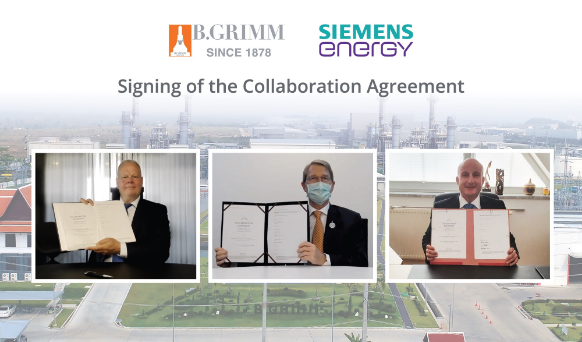
Applied to combined cycle co-generation power plants, which serve as key electricity sources in the Smart Grid through collaboration with leading partners, through collaboration with leading partners. The system enhances generation efficiency and cost-effectiveness, enables predictive maintenance through machinery health forecasting to minimise disruptions, and systematises operational data across complex workflows. (for more details, refer to “Operational Excellence and Customer Relationship Management” Topic).
Drone Technology Implementation
Thermal imaging drones has been deployed for the inspection and maintenance of transmission lines across Amata City Industrial Estates (Chonburi, Rayong, and Nong Lalok). This initiative enhances defect detection accuracy while significantly reducing preventive maintenance time and costs. Furthermore, it minimises safety risks associated with high-voltage equipment, ensuring a stable and reliable power supply. The application has expanded to include terrain surveys for new developments and corporate media, optimising resource efficiency, reducing carbon emissions, and supporting the transition to clean energy.
Future Energy Models & Renewable Energy Projects
We are developing scalable platforms to support the energy transition and customer sustainability goals.
Virtual Power Plant (VPP)
Leverages existing grid infrastructure to store "virtual energy" and balance supply and demand. Launched with floating solar power plants to build a stable network. It supports customers’ green energy goals through offering tailored solutions and continuous optimisation and grid stability management. To ensure reliable power supply, and promotes a sustainable, environmentally friendly energy future.
Virtual Power Purchase Agreements (Virtual PPA)
A digital platform facilitates clean energy allocation to customers outside industrial estates without physical transmission lines, aligning with our goal of expanding the market and promoting sustainability. It features a real-time dashboard that provides customers with in-depth insights to monitor and analyse their energy consumption and optimise costs effectively. The system processes electricity usage data to generate optimal energy usage plans, forecast future consumption, and deliver reports for customers and relevant authorities. Now fully operational and ready for the Third-Party Access (TPA) system, this solution provides industrial customers with a new energy alternative that enhances efficiency, reduces costs, and supports long-term sustainability goals.
Solar Rooftop Energy Solutions
Utilises Distributed Energy Resource Management System (DERMS) software to manage customer needs for solar rooftop projects, ensuring system stability for industrial customers.
Customers Solutions & Data-Driven Insights
We leverage data to drive value for customers, offering financial incentives and sustainability certification.
Energy-saving & Demand Response
We offers tailored discount structures based on individual customer electricity consumption patterns and implements Demand Response programmes that incentivise customers across all segments to adjust real-time energy use. These initiatives help maintain energy supply stability, preventing power outages, and aligns energy production and consumption with PPAs while strengthening infrastructure resilience. The programmes also enhance customer experience, strengthen customer relationships, and reinforce our position as a customer centric organisation withing a more flexible energy ecosystem.
Renewable Energy Certificates (RECs)
We uses RECs to drive demand for green investment and new renewable projects, supporting the reduction of indirect greenhouse gas emissions (Scope 2) from customers' energy consumption. RECs are sourced solar, wind, and hydro power, certified by internationally recognised standards under the I-Track Foundation’s I-REC(E) and endorsed by EGAT. One REC is equivalent to 1 MWh of renewable electricity generated. In 2025, we delivered RECs to 25 organisations.
AI-Driven Forecasting
We leverage cutting-edge data analytics and artificial intelligence (AI) to predict solar power generation and electricity loads, enabling proactive planning aligned with peak demand periods, minimising weather-related risks and load fluctuations. Additionally, the system supports optimal resource allocation and reserves management, enhancing operational stability and ensuring reliable electricity delivery to customers.
Customer Analytics Platform
Utilising real-time data to track and analyse customer energy consumption, we optimise contract management and minimise variance risks. This ensures strategies aligned with actual customer usage patterns, and ultimately enhancing operational efficiency, customer satisfaction, and preparing the platform for future TPA.
Driving Innovation Ecosystem & Venture Building
Incubate and drive innovation while preparing personnel to create growth and new opportunities.
Innovation Portfolio Management
We collaborate with world-class consultants, technology partners, and experts to drive innovation execution through cross-functional teamwork. Key activities include defining project scopes, planning, and testing solutions with internal and external teams to address challenges and identify optimal tools.
Fostering a Culture & Capabilities
Encouraging an innovation-driven mindset and adaptability, foster new ideas and building employee capabilities and encouraging idea creation across the organisation. Key programmes include:
- B.Grimm Ideation Awards 2025: Launched under the theme “Empowering B.Grimm with your Idea” to strengthen innovation capability aiming to create long-term innovation capability and encourage employees to develop and showcase business-relevant ideas in digital transformation and sustainability, by training and mentoring 44 participants from diverse business units, resulting in 15 high-potential project pitches. The programme supports both functional innovation and individual development, with selected ideas having potential to be scaled into future ventures. One notable project “B.Grimm SolarCare”, aims to establish a new O&M business services for solar rooftops and solar farms, demonstrating B.Grimm’s capability to deliver solar O&M services both within and beyond our grid.
- Innovator Training Programme: Provide training on innovation creation and innovation project management for employees with potential ideas through 7 sessions of training, including Design Thinking, Business Model Canvas, AI for Business, Consumer Behaviour, Business Mentoring and Pitching Essential. The goal is to help participants learn the creative practical process and how to develop ideas into tangible businesses.
- Design Thinking Workshop for New Employees: Equips new employees with design thinking fundamentals, with over 46 participants trained through the initiatives.
Adopting Digital Technologies and IT Systems
System Integration & Workflow Optimisation
Middleware for System Integration
Being developed to seamlessly connect various systems within the organisation, enhancing efficiency through real-time APIs (Application Programming Interfaces). This reduces redundant processes and improves data exchange efficiency and allows the organisation to respond swiftly and effectively to technological and business changes. Furthermore, it reduces operational costs, such as those associated with system management and resolving technical issues caused by unlinked systems.
IT Service Management (ITSM)
Being adopted to manage IT services with enhanced efficiency, transparency, and traceability. This includes clear tracking from incident reporting and diagnosis to rapid problem resolution. ITSM reduces operational delays and allows IT teams to focus on strategic initiatives.
Single Sign-On (SSO)
Minimises password management issues and enhances authentication security, preventing unauthorised access and strengthening overall cyber security while reducing IT workload.
Cloud Transformation and Security
Cloud Migration
Key functions are being migrated to flexible, modern cloud platforms to improve operational efficiency and security, while mitigating risks associated with outdated systems. This transition also helps lower energy costs compared to traditional systems that rely on numerous servers and hardware infrastructures.
Cloud-Based Disaster Recovery Site for Enterprise Resource Planning (ERP)
It has been set up for the ERP platform, enhancing system resilience, reducing the Recovery Point Objective (RPO) to 5 minutes in case a disaster emergency happens to prevent data loss and ensure business continuity. This approach also reduces reliance on traditional backup systems, lowering energy consumption and related costs.
Cloud Landing Zones
Enables the organisation to manage and clearly separate workspaces for production systems and non-production support systems. These zones include production environments, testing environments, data storage areas for troubleshooting, and user access control zones, all in alignment with the management standards of leading cloud service providers. In addition, comprehensive security policies are implemented—such as monitoring and logging—to prevent data breaches and cyber threats.
Data Platform for Decision-Making
Data Management Platform
Centralise and integrate data across all business units, creating a trusted, high-quality data foundation that accelerates decision-making, enables agile business processes, and prepares the organisation for scalable AI and advanced analytics adoption.
Business Intelligence (BI) Tool
Helps B.Grimm Power analyses key data and generate in-depth reports to support corporate strategies, such as business trend analysis and evaluating the success of various initiatives. In addition, it ensures that executives have comprehensive and accurate information for effective decision-making.
Loan Management System
Integrates with finance, accounting, and core enterprise systems to establish a single source of truth for loan data—improving data accuracy, reconciliation, reporting quality, and management visibility across the organisation.
Development of a Procurement Dashboard
Enables the procurement team to accurately consolidate and analyse in-depth spending data across different areas. This supports strategic procurement planning, enhances transparency, and promotes cost-efficiency.
Leverage of Low-Code Platforms
Rapidly and efficiently develop applications tailored to department’s needs, reducing dependency on external developers, optimises costs, and enhances employee capabilities.
The transition to the digital era is a crucial step in enhancing our competitive capabilities. We have invested in system development and personnel upskill to respond to the challenges of the digital age and to create long-term value for the business.